T.E.Lawrence and the Red Sea Patrol: The Royal Navy's Role in Creating the Legend by John Johnson Allen
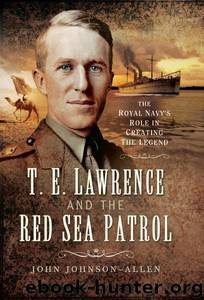
Author:John Johnson Allen [Allen, John Johnson]
Language: eng
Format: azw3, epub
Tags: HISTORY / Military / World War II
ISBN: 9781473859616
Publisher: Pen and Sword
Published: 2015-06-29T16:00:00+00:00
Despite the prohibition by Sherif Ali on the landing of naval officers, Fox landed her Medical Officer and a support party to help the Arab wounded.
Dufferin arrived on the 13th and joined in the bombardment, followed the next day by Perth, and from 1630 on that day all four ships were bombarding the town.
On the following day the seaplane carrier Ben-my-Chree arrived. She had sailed from Perim, en route for Port Sudan to take on coal, but was diverted to Jeddah. After conferring with Boyle, seaplanes SP850, SP3790 and SP3789 were lifted out and launched into the waters of the harbour, in the late afternoon, from where they took off in ideal conditions from a calm sea and with a light wind. They proceeded to bomb and machine gun Turkish positions. One of the planes, manned by Commander Samson, with Lt Wedgwood Benn as observer, carried out photo reconnaissance, before dropping a 112 pound bomb on a gun position. Enemy fire damaged the aircraft and one bullet removed the heel from one of Cmdr Samson’s shoes. He managed to land the aircraft on the water safely before the engine seized (this was not remarked on in the pages of the log). Samson was the Captain of the Ben-my-Chree and, as mentioned in Chapter Two, was one of the early pioneers of naval aviation. It is, to today’s eyes, at the least unusual that the Captain would himself fly on an attack, given the risks. He would seem to have had the unshakeable confidence of the professional naval officer in his invulnerability. The effect on the Turkish defenders, who, despite firing on the aircraft would have experienced little or no aerial attack before, must have been enormous. The effect on the Arab residents of Jeddah would have been even greater. The likelihood that any would have seen aircraft before was slight; to see craft leaving the water and then drop bombs and machine gun Turkish positions from the air would have been beyond their comprehension. The aerial attack took less than an hour. That, combined with the bombardment from the five ships, caused a white flag to be raised over Jeddah shortly after the aerial attack. During the early morning of the next day, at 0300, a messenger from the Emir of Harb arrived on board Fox with a message for Boyle confirming that the Turkish garrison had surrendered. This comprised 45 officers, 1460 men and 16 guns. A large amount of military stores was also captured, which was of great use to the Arabs. Boyle signalled to Ben-my-Chree after the surrender that “probably the seaplanes decided the matter.”3 So, having decided the matter, Ben-my-Chree proceeded across the Red Sea to Port Sudan to take on coal.
Capturing Jeddah was a great success for the start of the revolt. A port of strategic importance, it gave access for supplies to be sent inland and gave an unrestricted means of communication with Cairo. The telegraph cable to Jeddah was quickly repaired; the navigation marks to aid ships entering the port were replaced so that it could be fully utilised.
Download
T.E.Lawrence and the Red Sea Patrol: The Royal Navy's Role in Creating the Legend by John Johnson Allen.epub
This site does not store any files on its server. We only index and link to content provided by other sites. Please contact the content providers to delete copyright contents if any and email us, we'll remove relevant links or contents immediately.
Waking Up in Heaven: A True Story of Brokenness, Heaven, and Life Again by McVea Crystal & Tresniowski Alex(37809)
Empire of the Sikhs by Patwant Singh(23085)
We're Going to Need More Wine by Gabrielle Union(19046)
Hans Sturm: A Soldier's Odyssey on the Eastern Front by Gordon Williamson(18590)
Leonardo da Vinci by Walter Isaacson(13336)
The Radium Girls by Kate Moore(12028)
Tools of Titans by Timothy Ferriss(8395)
Educated by Tara Westover(8054)
How to Be a Bawse: A Guide to Conquering Life by Lilly Singh(7486)
Permanent Record by Edward Snowden(5847)
The Last Black Unicorn by Tiffany Haddish(5635)
The Rise and Fall of Senator Joe McCarthy by James Cross Giblin(5280)
Promise Me, Dad by Joe Biden(5153)
The Wind in My Hair by Masih Alinejad(5095)
A Higher Loyalty: Truth, Lies, and Leadership by James Comey(4964)
The Crown by Robert Lacey(4817)
The Iron Duke by The Iron Duke(4356)
Joan of Arc by Mary Gordon(4110)
Stalin by Stephen Kotkin(3965)
